Starting January 1, 2027, NYC requires owners of multiple dwellings, and of one and two family homes that are not owner occupied, to install natural gas detectors when the building has gas piping. Nationwide Plumbers installs UL 1484 listed battery and plug-in alarms, and checks the gas appliances and connectors while we are there. Call 718-748-2727.
Who needs natural gas detectors
The requirement comes from Local Law 157 of 2016. HPD says owners of all multiple dwellings (Class A and Class B), and of one and two family homes that are not owner occupied, must provide and install at least one approved and operational natural gas detector when the building has gas piping. In Brooklyn that covers the pre-war walk-up, the co-op or condo building, and the brownstone or row house rented out as one or two apartments.
The deadline: January 1, 2027
When we checked on November 20, 2026, both the HPD detectors page and the DOB natural gas detector FAQ gave January 1, 2027. The date has moved before: the original deadline was May 1, 2025. Under the City Council bill that postponed it, the deadline can move to January 1, 2029 if DOB finds there are not enough compliant alarms available. Plan for 2027.
Where each alarm goes
- In the same room as the gas appliance, at least 3 feet and not more than 10 feet away, measured horizontally.
- On the ceiling, or on the wall no more than 12 inches below the ceiling.
- An apartment with no gas appliance still needs one when the area directly below it has a gas appliance or gas piping.
- Common spaces with a gas appliance need one too. DOB makes an exception for a boiler or water heater in a centralized, restricted room.
How we handle it
- Count what the building needs. We confirm which apartments and common spaces need an alarm.
- Install the alarms. We install battery or plug-in alarms listed and labeled to UL 1484 with an end of life alarm, as HPD requires, in the right spot in each room. Hard-wired alarms must be installed by a New York City licensed electrical contractor.
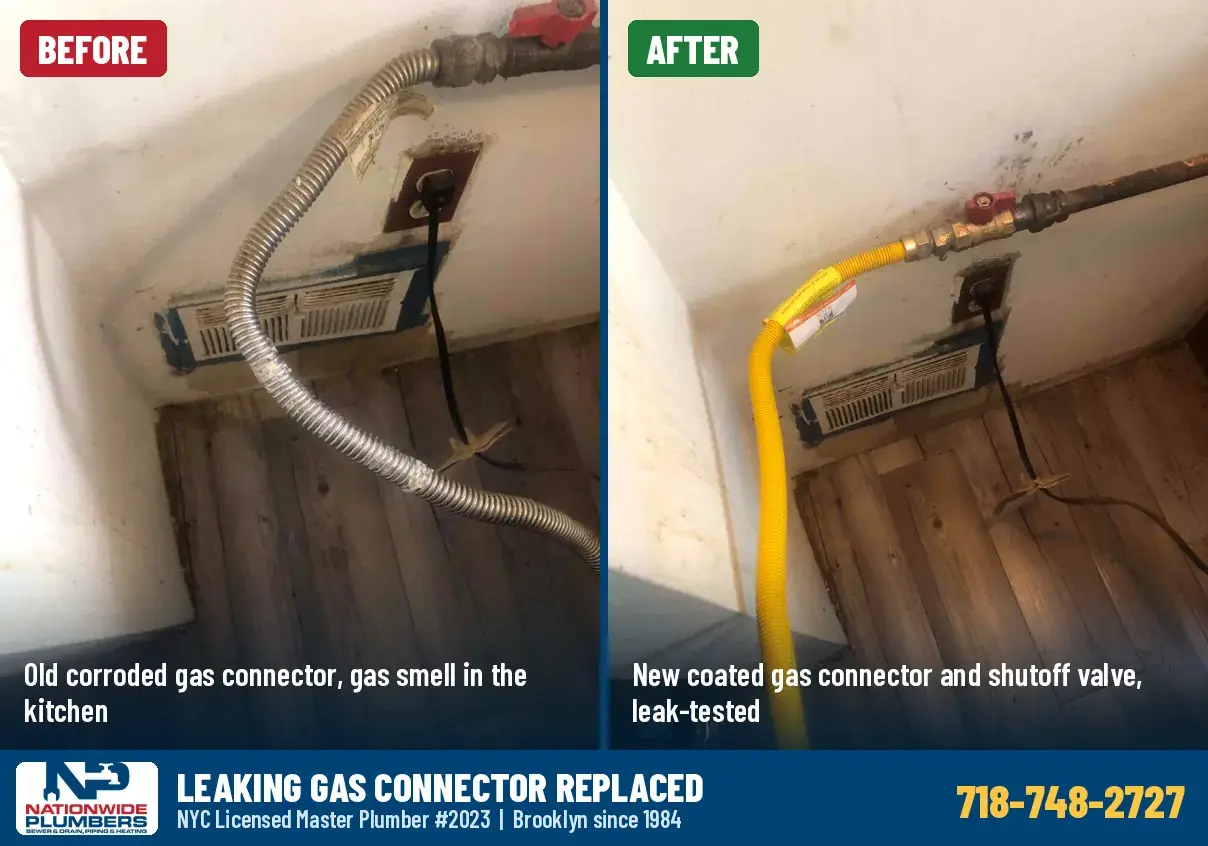
- Check the gas work while we are there. An alarm only tells you gas is in the air. As licensed master plumbers we look at appliance connectors, shutoff valves and visible piping, and tell you in writing about anything that needs repair.
- Help with the paperwork. HPD asks owners to post a notice in the entrance of a multiple dwelling, give each apartment a testing and maintenance notice, and keep a record of each device's install and expiration dates.
For the full rules, read our guide: Do NYC apartments need natural gas detectors by January 1, 2027?
If an alarm goes off
Do not look for the source yourself. Leave the building, do not flip switches, and call 911 from outside. Once the building is safe, call us at 718-748-2727 to find and repair the leak.
What it costs
No single number fits every building. The number of apartments and gas appliances, battery or plug-in alarms, and anything the walk-through finds that has to be fixed first are what move the price. You get a written price before any work starts. In Class A buildings and one and two family rentals, HPD lets owners collect a set reimbursement from tenants for a newly installed device; the amounts are on the HPD page.
Natural Gas Detector Installation: FAQ
When do natural gas detectors become required in NYC?
HPD and the Department of Buildings both give January 1, 2027. The City Council bill that set this date allows it to move to January 1, 2029 if DOB finds there are not enough compliant alarms available, so check the HPD page before ordering for a whole building.
Who has to install them?
The owner. HPD says owners of all multiple dwellings, and of one and two family homes that are not owner occupied, must provide and install at least one approved natural gas detector when the building has gas piping.
Where does the alarm go?
In the same room as the gas appliance, at least 3 feet and not more than 10 feet from it measured horizontally, on the ceiling or on the wall within 12 inches of the ceiling. In most apartments that is the kitchen.
Can you install hard-wired alarms?
Hard-wired alarms must be installed by a New York City licensed electrical contractor, with permits. Battery and plug-in alarms do not need an electrician.
What does it cost?
It depends on the number of apartments and gas appliances, the type of alarm, and whether the walk-through finds gas work that has to be fixed first. You get a written price before any work starts.