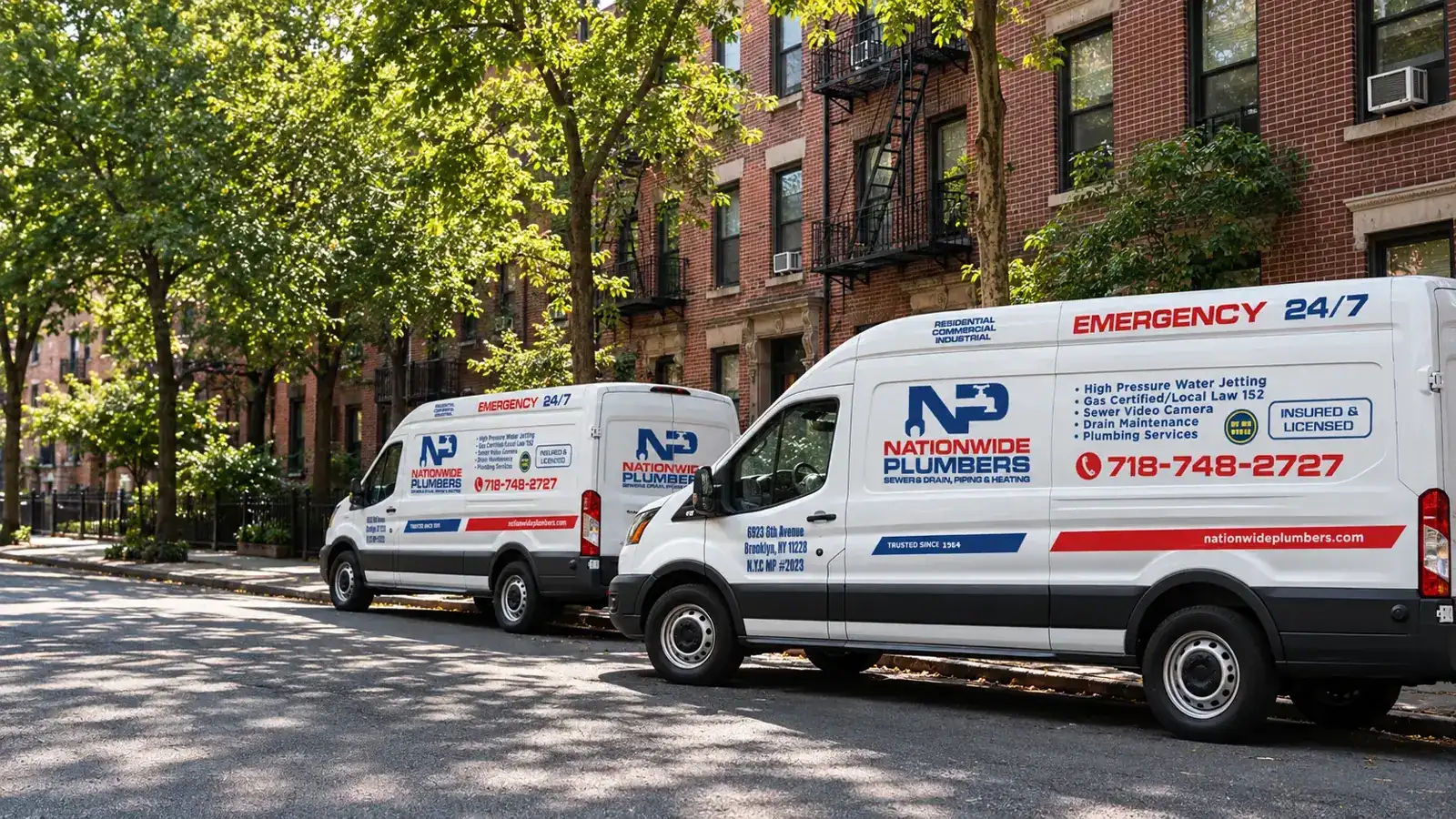
Nationwide Plumbers is a NYC Licensed Master Plumber, License #2023, serving the city since 1984 with 24/7 emergency dispatch. On Grymes Hill we handle long sewer and water lines, boilers in large homes, and Local Law 152 work for co-ops and apartment buildings. Call 718-748-2727.
Grymes Hill rises above the North Shore with views across the harbor, and its winding main road, Howard Avenue, climbs past Wagner College and the Staten Island campus of St. John's University. The hill holds some of the borough's older large houses, many set well back from the street on sloped lots, along with mid-century homes and apartment buildings and co-ops along Howard Avenue. Clove Road and the Staten Island Expressway run along its lower edges.
Building on a steep hill changes the plumbing. Sewer laterals and water services can run long distances from the house to the street, sometimes through rock. Drain lines on a steep pitch behave differently than on flat ground. Big older houses often carry large hot water or steam heating systems. And the apartment buildings face the same gas piping and boiler compliance as anywhere else in the city. We cover Grymes Hill 24/7.
Services we offer in Grymes Hill
- Sewer camera inspection of long hillside laterals
- Sewer line repair and replacement on sloped lots
- Water service line replacement for houses set back from the street
- Boiler repair and replacement for large homes
- Local Law 152 inspections for co-ops and apartment buildings
- Property management accounts with COIs for boards
- Water heater installation, including high-capacity and tankless units
- Leak detection and repair
Common plumbing issues in Grymes Hill
Long sewer runs on steep lots
When a house sits high above the street, the sewer may run a long way down a slope to reach the city main. Older clay or cast iron pipe on a hillside can crack where the ground moves, and joints can separate. Because the line is long, guessing where the problem is gets expensive. A camera inspection with a locator marks the exact spot so a repair digs in one place.
Water service lines through rock and yards
The same distance applies to the water service. An old line running up a long driveway or across a yard can leak underground for a long time before it shows. Water surfacing on the slope, a meter that moves with everything off or a drop in pressure are the usual signs. We confirm the leak and quote a replacement in writing.
Heating big older houses
Large houses on the hill often have oversized boilers serving many radiators, sometimes with zones added over time. These systems can be expensive to run and slow to heat. We service the existing boiler, balance the zones and, when replacement comes up, size a new boiler to the actual heat loss of the house.
Why Grymes Hill residents choose Nationwide Plumbers
- Licensed Master Plumber since 1984, License #2023, insured
- COIs and written estimates for co-op boards and managing agents
- 24/7 emergency dispatch
- Free estimates on sewer, water line and boiler replacements
Service area in and around Grymes Hill
We service all of Grymes Hill, Staten Island (ZIP 10301, 10304), for emergencies 24/7 and for scheduled work.
Nearby neighborhoods we also serve: Silver Lake, Emerson Hill, Sunnyside, Stapleton and Tompkinsville. For our full coverage, see our Staten Island service area page.
Plumbing in Grymes Hill: FAQ
Why does my sewer back up when my house is at the top of a hill?
Being uphill does not protect the line itself. Roots, a cracked pipe or a separated joint can block flow anywhere along a long lateral. We clear the line and camera it to find the cause, then explain the options for a lasting repair.
Does our co-op building on Howard Avenue need Local Law 152 inspections?
Yes, if the building has gas piping. Local Law 152 covers buildings other than one and two family homes. We inspect the exposed gas piping, provide a written report to the board, and file the GPS2 certification. Call 718-748-2727 to schedule.
Can you replace a water line without tearing up my whole yard?
In many cases, yes. Depending on soil, rock and the route, we may be able to limit digging to access points. We assess the site first and give a written estimate that explains the method we plan to use.