Your building is exempt from Local Law 152 gas piping inspections only if it is a one or two family home, falls in Occupancy Group R-3, carries one of the Department of Buildings' listed exempt building classifications, or has no gas piping at all, and that last case still requires a one-time certification filed with DOB.
- One and two family homes and other buildings in Occupancy Group R-3 do not need the periodic inspection.
- Buildings with no gas piping are not inspected, but the owner must file a certification, signed and sealed by a Licensed Master Plumber or a registered design professional, saying so.
- Everything else with gas service, including three family homes, walk-ups, brownstone rentals, co-ops, condos and mixed-use buildings, must be inspected by a Licensed Master Plumber at least once every four years.
- Gas piping and appliances inside individual dwelling units are exempt; the law covers exposed piping in common and non-residential spaces.
- Your deadline year depends on your community district, and the certification is filed in DOB NOW: Safety.
Who is actually exempt
Local Law 152 of 2016 requires periodic inspection of building gas piping systems. The NYC Department of Buildings states that the requirement applies to all buildings except one and two family homes and other buildings classified in Occupancy Group R-3, the building code's group for small residential buildings that are not multiple dwellings.
DOB also lists the Department of Finance building classifications that do not need to comply. As of our check on November 11, 2026, that list is A0 through A9 (one family dwellings), B1, B2, B3 and B9 (two family dwellings), CM, M3 with two or fewer permanent dwelling units, M4 with twenty or fewer occupants, N2, S0, S1, S2 and V (vacant land). If the class on your Finance tax bill matches one of those, you are outside the law.
Two points trip up Brooklyn owners. First, the exemption follows the legal classification, not how the house feels. A three family brownstone in Park Slope or Bedford-Stuyvesant is not R-3 and must be inspected, even if the owner lives there. Second, a rear house or detached garage with its own Building Identification Number (BIN) is treated separately. DOB's LL152 FAQ says each BIN must be filed separately, so one property can have one exempt structure and one that is not.
No gas piping: exempt from inspection, not from filing
If a building has no gas piping, for example an all-electric new construction condo in Williamsburg or a converted loft with electric heat and cooking, there is nothing to inspect. DOB still requires the owner to submit a certification stating that the building contains no gas piping, signed and sealed by a Licensed Master Plumber or a registered design professional (a New York State licensed professional engineer or registered architect).
DOB's FAQ says this certification only needs to be submitted once, with one catch: if there is still active gas service to the building, for example a capped line or a meter that was never removed, periodic recertification every fourth year may be required. A licensed plumber can confirm whether the service was fully disconnected and whether any piping remains behind walls.
Inside the apartment versus the common areas
Tenants and shareholders often ask whether the inspector will come into their unit. In most cases, no. Local Law 142 of 2025 amended the program and extended coverage to commercial spaces, and DOB's FAQ states that gas piping, equipment, appliances and points of connection located within dwelling units are exempt.
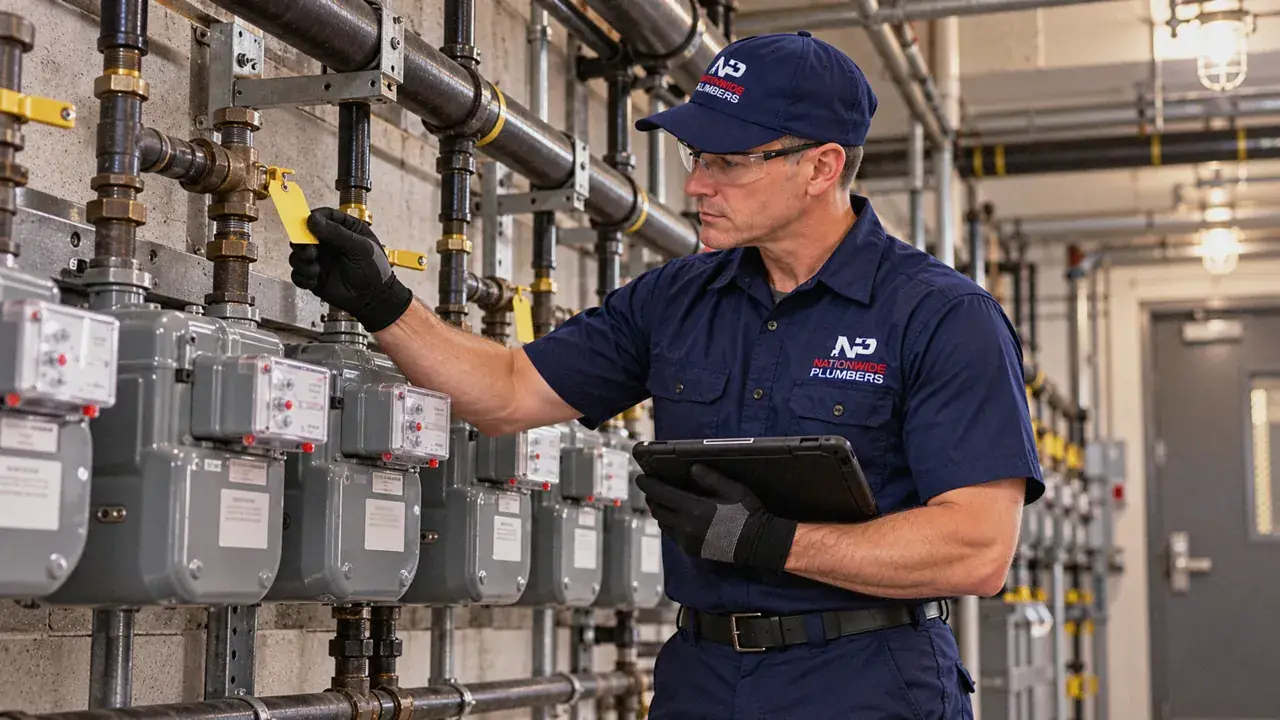
What is inspected is the exposed gas piping from the point of entry into the building through the point of connection to appliances in common and non-residential areas: cellars, meter rooms, boiler rooms, hallways, rooftops and commercial tenant spaces. Where piping is concealed, the plumber uses a combustible gas detector in public halls and corridors on floors that carry gas piping. In a pre-war co-op on the Upper West Side or a six-story walk-up in Sunset Park, that means the cellar, the risers in the public halls and the super's room, not your kitchen.
When is my building due
Buildings that are not exempt are inspected at least once every four years, in the year assigned to their community district. The DOB schedule, verified on the Department's gas piping inspection page, is:
- Community Districts 1, 3 and 10: 2024, then 2028.
- Community Districts 2, 5, 7, 13 and 18: 2025, then 2029.
- Community Districts 4, 6, 8, 9 and 16: 2026, then 2030.
- Community Districts 11, 12, 14, 15 and 17: 2027, then 2031.
The numbers repeat in every borough. In Brooklyn, Park Slope, Carroll Gardens and Red Hook (CD 6), Bushwick (CD 4), Crown Heights (CD 8 and 9) and Brownsville (CD 16) are due by December 31, 2026. Bay Ridge and Dyker Heights (CD 10), Williamsburg and Greenpoint (CD 1) and Bedford-Stuyvesant (CD 3) come due again in 2028. Confirm your district with DOB's address lookup tool, because district lines do not follow neighborhood names exactly.
After the inspection, the Licensed Master Plumber must give the owner a report within 30 days, and the certification must be filed with DOB within 60 days. DOB's FAQ notes that as of July 27, 2026 the old GPS1 and GPS2 forms are no longer required or accepted; the same information is entered directly in DOB NOW: Safety. Conditions that need repair must be corrected and certified within 120 days, or within 180 days if additional time is requested. Unsafe conditions such as an active leak are reported immediately to the owner, the utility and DOB.
What a licensed plumber checks before saying you are exempt
A plumber who knows this law does not take the owner's word for the building type. On a first visit we check the Finance building class and the Certificate of Occupancy on DOB's system, count the legal dwelling units, confirm whether any rear structure has its own BIN, and look at the meter bank and service entry in the cellar. If the building has no gas, we trace where the service was cut so the no gas piping certification is accurate when it is signed and sealed.
When to call a plumber
Call a Licensed Master Plumber if you are not sure of your building's occupancy group or Finance class, if your building has three or more units and has never filed, if your community district is due this year or next, if you own an all-electric building that has never submitted the no gas piping certification, or if you smell gas anywhere in the building. The last one is an emergency: leave, call the utility and 911 from outside, then call us.
Nationwide Plumbers has worked on gas piping in Brooklyn, Manhattan and Queens since 1984, and our inspections are certified under NYC Licensed Master Plumber #2023. See our Local Law 152 inspection page for how the inspection works, our guide for co-op and condo boards if you manage a building, and what happens after a failed inspection if your last report found problems. Call 718-748-2727 for a written estimate.
Local Law 152 exemption FAQ
Is a three family house exempt from Local Law 152?
No. The exemption covers one and two family homes and other Occupancy Group R-3 buildings. A legal three family house is a multiple dwelling and must be inspected on its community district schedule.
My co-op is all electric. Do we still have to do anything?
Yes. DOB requires a one-time certification, signed and sealed by a Licensed Master Plumber or a registered design professional, stating that the building has no gas piping. If gas service is still active to the building, recertification every fourth year may be required.
Does the inspector need to enter every apartment?
No. Gas piping, equipment and appliances inside dwelling units are exempt. The inspection covers exposed piping in common areas, mechanical spaces and non-residential tenant spaces, plus a combustible gas detector sweep of public halls on floors with gas piping.
My building has stores and apartments. Are the stores covered?
Usually, yes. Local Law 142 of 2025 extended coverage to commercial spaces, so the gas piping serving a ground-floor restaurant or laundromat in a mixed-use building is part of the inspection. The exception is a one or two family home with a store, Finance classes S0, S1 and S2, which stays on DOB's exempt list.
What if I miss my community district's deadline?
DOB says an owner who misses the filing deadline, extended or otherwise, is liable for a civil penalty. A one-time 180-day extension can be requested before the deadline, but the building must still be inspected before the extension runs out.
Who can perform the inspection?
A Licensed Master Plumber, or a qualified individual working under that plumber's supervision. The Licensed Master Plumber always certifies the inspection in DOB NOW: Safety.
Official sources
- NYC Department of Buildings, Periodic Gas Piping System Inspections
- NYC Department of Buildings, LL152 of 2016 FAQs
- Local Law 152 of 2016 text (PDF)
Call Nationwide Plumbers at 718-748-2727, we answer 24/7.